
At this point, it may well be silly to recommend this book. It’s been out for almost two and a half years, and the movie adaptation (by the Coen brothers – HOORAY!) will be in theaters in a few short months. On top of that, Cormac McCarthy has jumped on the Oprah train with his most recent book, The Road. The publicity machine running behind this phenomenal author and his amazing work doesn’t seem to be hurting for fuel. All that being said; this book is so good that it would be wrong of me to read it and not say something.
Monday, September 24, 2007
No Country For Old Men - Cormac McCarthy


Wednesday, September 19, 2007
Two Quickies - The Shock Doctrine "trailer" by Naomi Klein & 52 Projects / Working for the Man by Jeffrey Yamaguchi
Both of these interesting finds come by means of exchange. The Naomi Klein video comes recommended by Noel, whom I spoke with briefly at our Downer Ave shop last night. This book hit the shelves yesterday and seems poised to fly into the hands of a wide, discerning readership.
 The 52 Projects link comes from the extremely
unpersonal (and admittedly amazing) Feedburner statistics. (Plug: subscribe to our feed, if you haven't already.) Say what you will about Williamsburg, but I am certainly a fan of spontaneous - or prescription-aided - public art. Make your community beautiful!  52 Projects is available now; Working for the Man will be in stores in November - but is, of course, available for pre-order now.
Friday, September 14, 2007
Presenting Punk: Year-Round Gifts For The Punk At Heart - By Denise Dee
There's so much emphasis in the book industry about selling the 'latest' books. I might be a bit of an aberration in that I am much more excited about selling older books. I am passionate about books I consider 'classics'; and don't worry - I'm not talking about ones that were crammed down your throat in school or by some well-meaning friend. These books are must-haves for your punk library.

Sometimes it is necessary to go backwards to go forwards and Heylin gives us an excellent history of the music leading up to punk. How can you understand Richard Hell without first taking a look at John Cale and Johnny Thunders? Glam gets trashed and later thrashes in this book which moves from New York to London to Cleveland with a few stops in other cities. Cleveland gets long-deserved credit for contributing many seminal members to the punk rock scene. I read this on a Greyhound bus trip and pictured people leaving their hometowns to go find a place where they could 'fit in'. Heylin nails the simultaneous excitement of rebellion and belonging.
 Punk: The Definitive Record of a Revolution by Stephen Colegrave.
A must-have if for no other reasons than the price and pictures. This stunning book is only $25 and will have you 'You Tubing' videos of bands that you may have forgotten about (or never heard of in the first place). Of course, it would be impossible to have a 'definitive' book that you could actually lift - but this book does a nice job of mixing bands that stayed around for a while with one or two-hit wonders. This makes a great gift.
Please Kill Me: the Uncensored Oral History of Punk by Legs McNeil and Gillian McCain.

 My heart belongs to punk. But I think it's important to see where punk went and some reasons why. Reynolds covers no wave, new wave and other postpunk movements. Essential reading if for no other reason than the chapter on the No Wave bands. Their influence spread way beyond the sparse number of groups and audience members involved in the scene. If you can find it purchase No New York and listen to it while reading this chapter. Reynolds visits some of the West Coast punk bands and you start to get a sense of how punk changed in California and then again as it spread across the country.
 Psychotic Reactions and Carburetor Dung by Lester Bangs. Edited by Greil Marcus.
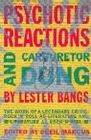
Detroit is another city that had enormous influence on not only the punk scene but on music in general. Could much of American music exist without Detroit musicians? I don't think so. Lester Bangs was an early rock critic who found a home in Detroit writing for Creem magazine. He knew the Stooges, the MC5, Patti Smith, Destroy All Monsters, as well as jazz, soul, and blues musicians. His writing style is very much no punches pulled. It shows how raw energy that used to be worked out in fist-fights could be turned into a song or an article. Be ready to laugh and to call up friends and read them passages from this book.
Monday, September 10, 2007
Samedi the Deafness - Jesse Ball
Samedi the Deafness, the first novel from poet Jesse Ball, is generating excitement within a range of booksellers and bookshops at Harry W. Schwartz. I've enjoyed about two-thirds of its mystical pondering and abstract maze and will add my thoughts to those of my fellow booksellers when I find ninety minutes to finish this quick-flowing paperback original.
"This book confounds me every time I attempt to summarize or describe it. The story screams and clamors every time I pick it up and try to put it in a box. It's diamond-like in its brilliance and multi-facetedness.
James Sim is a character unlike any other I've encountered. He's also similar to many others in that the harder he tries to solve the situation confronting him, the further he falls into the hole, like Alice in Wonderland.
I've attempted to describe this novel to friends, customers and colleagues in the following ways: real, surreal, Kafkaesque, a spy novel, a love story, a puzzle. It is all and none of these things. It is itself and itself alone.
I could describe the rest of the amazing cast of this gorgeous, reverberant novel, but all I'll say is: please, please do yourself a favor and read it."
--Carl Hoffman, Bayview
"Immediately steeped in this mind-bending novel, I couldn't stop reading even as the world around me felt more surreal with the turn of each page. I felt pulled with the protagonist from everyday life to find myself at wits' end, faced with treachery, deceit, and anxious anticipation. The day I finished reading the book, I ate a fortune cookie which read, "Every half-truth is a lie"; in that same vein, we find in every lie, a half-truth."
--Wil Tietsort, Shorewood
I've heard nothing but praise about his poetry, too, and it should appeal to fans of Josh Bell and David Berman. Or so I hear.
Tuesday, August 28, 2007
Slush Pile Update - Eli Horowitz, McSweeney's
In response to my thoughts on the slush pile in contemporary publishing, McSweeney's Editor Eli Horowitz answers some questions on their slush pile. McSweeney's next book is Millard Kaufman's Bowl of Cherries.
Eli Horowitz: I don’t know if we really have a slush pile here — not because we don’t take unsolicited manuscripts, but because almost everything sits in the same pile. Sometimes we’ve heard of the writer, or someone recommended them, and some others are sent by agents, but still they all mush together. So it’s not like a daring expedition into the darkest swamps — it’s no swampier than our overall book-reading procedure (which is fairly swampy throughout).
Jay Johnson: How deep is your slush pile of novel-length manuscripts?
EH: Only ankle-deep, but several yards wide.
JJ: How many unsolicited manuscripts do you receive monthly?
EH: For books, maybe fifty? (A lot more for stories.)
JJ: How often do you read manuscripts out of the slush?
EH: All the time.
JJ: How many slush authors receive correspondence?
EH: Well, they all receive something, or they all should. But do you mean personal notes? Pretty rarely.
JJ: How many books have you published from slush?
EH: Again, it depends what you call slush, but at least half our novels, I think: Here They Come, Icelander, Bowl of Cherries, etc.
JJ: Do you and your assistant editors eat pizza, salads, or both?
EH: Burritos.
JJ: Would you rather read a slush pile MS or create a marketing sheet?
EH: I don’t even really know what a marketing sheet is.
Monday, August 27, 2007
Modern Life - Matthea Harvey
 I've spent a lot of time and a considerable amount of money trying to connect with Matthea Harvey. I don't mean transcontinental jaunts or long-distance telephone calls, I mean diving into Sad Little Breathing Machine, ending my day with Pity the Bathtub Its Forced Embrace of the Human Form. Honestly, they've never really done it for me. So, when Modern Life arrived with the mail I decided to give it one last go.
And finally, it happened.
Harvey has developed into a master of prose. Her stories are abstract, surreal and bare-boned. "The Future of Terror" series puts so eloquently and almost slightly encoded, the feelings felt by millions as the politics of the last six years unfurled revealing smoke and mirrors, indescribable feelings of loss as our elected officials' transparencies became real. The setting is a direct route to apocalypse.
from 'The Future of Terror/3'
We wore gasmasks to cross the gap.
Goodnight, said the gravediggers, goodnight.
We looked heavenward but kept our hands
down when they asked for volunteers
so they simply helped themselves.
Our protestations sounded like herons
on the hi fi.
Progressing into a manifesto about the ridiculousness of the popularized/packaged idea of fear which has become the center of a maelstrom no one takes seriously, Harvey also touches on the very sincere inflection one has when all hope is seemingly lost, the unrelenting influence of nature and imagination.
from 'The Future of Terror/11'
Here was my hypothesis: we were inextricably
fucked. We'd killed all the inventors and all
the jesters just when we most needed humor
and invention. The lake breeze was lugubrious
at best, couldn't lift the leaves.
Beyond this series there are great, brief forays into new channels of physical and other observation- felt out by characters and a narrator extremely close to the work of Aimee Bender- which I naturally adore.
Bad Monkeys - Matt Ruff

Confession time; I loathe high-octane action novels following rogue CIA/FBI/NSA agents as they untangle a web of government corruption while saving the president’s daughter. Luckily, Matt Ruff’s Bad Monkeys is nothing like those. Sure, there’s a national conspiracy, shadowy cabals on both sides of the good and bad seesaw, and a rogue agent shooting her way through the danger; but her weapon of choice is an ‘NC Gun’, ‘NC’ of course, standing for Natural Causes.
Ruff has done the action genre a service by weaving some fantastical elements into what would otherwise seem by-the-book spy fare. In fact, with these additions, Bad Monkeys goes from airport read to a mindbender of a good time from the first chapter on.
The enigmatic Jane Charlotte is questioned about a murder she cops to in the name of The Organization. The Organization is an outfit dedicated to improving the world behind the scenes, and her branch takes care of the titular primates. Bad monkeys; too far gone to save, too diabolical to be allowed to go on living. It’s Jane’s job to hunt them down, using a variety of sci-fi tech and weaponry and the Big Brother-style surveillance provided by every eye they could hide a camera in.
Read on an action thriller level, Bad Monkeys would succeed easily. It’s a good thing that Ruff wasn’t satisfied with action thriller status. Jane’s story is picked apart at every turn by a doctor and fed back to her in a more believable and less heroic form. The reader is left to figure out what’s to be believed and who Jane is. The psychological aspect of Bad Monkeys is at least as important as the derring-do, and delivers on the Pynchon-esque promise of the premise.
Bad Monkeys reminds me of another twist-and-turn action story recently out in paperback; The Zero, by Jess Walter. I loved Walter’s book for many of the same reasons I find Ruff’s to be so engaging. It just goes to show; genre need not scare you away if it’s used as a basis for expansion and experimentation. Both action novels succeed brilliantly by melding some sci-fi in with their grit.


