You know the moments where the world seems perfect and beautiful precisely because of all it's diversity and faults? When you are plugged into an iPod listening to music while waiting at the airport and everyone appears to move to the music in an odd synchronization? Or when you look out upon a snowy world in all its silent splendor and for a brief second, everything is a glimpse of heaven? Or a split second of utter and complete zen-like happiness descends upon you at the most routine time (showering, eating breakfast, shaving, walking the dog, watching a child at play)?
It is that precise moment when the world is illuminated in a way that you are left breathless; for your heart flutters a few times and it's as if the world is such pure perfection that with one breath you will break its delicate magic spell.
That moment is what it is like to read Kevin Brockmeier's short stories. And his latest collection (The View From the Seventh Layer, arriving March 4, 2008 to an indie bookstore near you) is a shining beacon atop a whitewashed lighthouse of whimsical, haunting, original, perfect, fantastical prose. The stories are hypnotic, mesmerizing whiffs of fantasy blended with the brutal realities of human existence. From a thousand parakeets that mimic the daily sounds of a mute's life to a Choose-Your-Own-Adventure story of mundane proportions. From photos that observe a houseguest's every move and word to a man who buys a thrift store overcoat only to discover the former owner was God and that its pockets spill over with earnest, an
Brockmeier's gifts are in his precision writing: Each word carefully placed "just so", and in his effortless way of seeing beauty in the simplest things, the unlikeliest of people. To see the world through his literary windows is to learn to love unconditionally and not take for granted the billions of little things that mosaic our lives.
I know I only taunt readers with this review as you must wait nearly 2 months for this collection to arrive on shelves. But, Dear Reader!, it will be well worth the wait, I promise you! For your reward will be his presence at our Downer Avenue store on March 27th at 7pm. To tide yourself over I suggest reading his last novel (also something very, very special): The Brief History of the Dead. It will be only a taste of the magic that is to come.
Monday, January 7, 2008
Brockmeier's Multi-Layered Views


Wednesday, January 2, 2008
The List List
Many lists, one spot - that's the motto now! Rather than a post for each "best of 2007" list that I stumble upon or gets sent to me, I'm going to centrally locate all of those links, with copied content, right here.
I do it all for you, dear readers.
(NPR One's that Got Away can be found here. NYT and Washington Post are in the left column.)
Entertainment Weekly's Best (and Worst!) Books of 2007, because books are entertainment, too, lest you literatis forget!
The Best Books of 2007
EW critic Jennifer Reese honors the top ten in both fiction and nonfiction, and names five titles you'll be hard-pressed to give away at yard sales for years to come.
By Jennifer Reese
BOOKS: EW'S TOP 10 IN FICTION FOR 200710. THE TERROR by Dan Simmons
In this mesmerizing thriller, Dan Simmons offers one possible (if improbable) answer to the real-life question of what happened to a British naval expedition that vanished in the Arctic in 1845. In Simmons' version, the sailors confront challenges ranging from the mundane (anarchy, starvation) to the extraordinary (a soul-devouring demon, a seductive ''Esquimaux'' girl missing her tongue). You'll want to read this book in a warm, well-lit house stocked with plenty of grub and a few gills of rum. Though dauntingly long, Simmons' epic, like the frozen sea that trapped the sailors, holds you fast.
9. THE BRIEF WONDROUS LIFE OF OSCAR WAO
by Junot Díaz
Junot Díaz recounts the saga of Dominican-American nerd-boy Oscar in irresistible, high-energy Spanglish. Sample sentence: ''You really want to know what being an X-Man feels like? Just be a smart bookish boy of color in a contemporary U.S. ghetto. Mamma mia! Like having bat wings or a pair of tentacles growing out of your chest.'' That's Oscar's deal, but Díaz also has much to say about sci-fi fandom, bodacious chicas, and
an ancient family curse.8. OUT STEALING HORSES by Per Petterson
Trond Sander, the 67-year-old narrator of Per Petterson's quietly unsettling tale (gracefully translated from Norwegian by Anne Born), has moved to the countryside hoping to finish out his years in solitude. Then a chance encounter starts him eflecting on his past, in particular the shattering summer of 1948, when a freak accident and dawning revelations about his father's emotional allegiances turned his world on end. Beneath the wintry surface of this marvelous book, you'll uncover layers of mystery and sorrow.
by Joyce Carol Oates
Joyce Carol Oates is at the height of her considerable powers in this dark, lush novel loosely based on the life of her Jewish grandmother. After watching her German-born gravedigger father kill himself, Rebecca Schwart willfully reinvents herself, methodically erasing all vestiges of her immigrant past. What she gains in security and respectability is quickly apparent; what is lost becomes clear only in a devastating coda.
6. ON CHESIL BEACH by Ian McEwan
The year is 1962, and Edward and Florence, ''young, educated and both virgins, on this, their wedding night,'' are anticipating conjugal relations with equal parts eagerness (his) and fear (hers). What transpires is funny, embarrassing, dreadful, and all too believable. Sex can be a tricky, delicate business, as McEwan poignantly illustrates in this tiny and wise masterpiece.
5. A FREE LIFE by Ha JinYou could mistake the unadorned prose of Ha Jin's fifth novel for artlessness. In fact, his storytelling — direct, homely, affecting — represents a perfect marriage of subject and style. Nan Wu longs to write poetry, but instead takes a series of menial jobs to support his family. Over roughly 10 years, Nan folds dumplings, washes dishes, and clerks at a motel, while struggling to find the inspiration and time for literature.
Shimmering language has no place in this deeply felt portrait of the artist ground down by middle-class routine.4. LAST NIGHT AT THE LOBSTER by Stewart O' Nan
Another generous novel about work, this one set during a blizzard at a languishing Red Lobster restaurant in New England on its final day of operation. For the very last time, Manny DeLeon, Stewart O'Nan's grave hero, negotiates
between his bickering waitstaff, tends to the Frialators, banters with a longtime customer, and pushes the tilapia. Without quite admitting it to himself, he is mourning the dissolution of this strange little community, however makeshift and dreary. And why shouldn't he? O'Nan turns everyday loss into poetry.3. THEN WE CAME TO THE END by Joshua Ferris
Novelists work in their pajamas, which explains why fiction so rarely gets office life quite right. Joshua Ferris' dazzling debut is an exception. Set in a Chicago ad agency, the action consists primarily of the rumor peddling, flirting, and time wasting familiar to most white-collar drones. Just when you think this is merely a glib literary stunt, Ferris shifts into a somber and lovely minorkey. ''Every agency has its frustrated copywriter whose real life was being a failed novelist working on a small, angry book about work,'' the narrators tell us. This is a large, generous book about work.
2. SHAKESPEARE'S KITCHEN by Lore Segal
When gregarious New Yorker Ilka Weisz takes a job at a small-town Connecticut think tank, she worries she'll never find new friends. But Ilka, introduced in Lore Segal's 1985 novel, Her First American, is quickly embraced by an insular clique of intellectuals who drink martinis, obsess over poetry prizes, philander, and gab about it all nonstop. Billed as a story collection, the volume starts off as fizzy academic comedy. By the time you realize that you're actually reading a novel — and that it's profoundly sad — this sneaky, splendid book is over.
1. THE POST-BIRTHDAY WORLD by Lionel Shriver
In a year when nearly everyone was caught up in the story of a young wizard, an ensorcelling book about a mortal adult woman went virtually unnoticed. The heroine of Lionel Shriver's extraordinary novel The Post-Birthday World is Irina McGovern, an illustrator living in London with her longtime partner, Lawrence Trainer, an earnest policy wonk. They share values and routines, if not a world-beating sex life. As the first chapter ends, Irina finds herself alone with a roguish acquaintance, pro snooker player Ramsey Acton, whom she's always found dangerously attractive.
Here, the novel branches into two competing narratives. In the
first, Irina kisses Ramsey. In the second, she resists. Chapter by chapter, these two richly imagined scenarios play themselves out, eventually meeting up again some 500 pages later. Which was the better choice for Irina — the steamy lover Ramsey or the steady companion Lawrence? Shriver playfully suggests
answers, only to snatch them back again.Before it was co-opted and trivialized by chick lit, romantic love was a subject that writers from Flaubert to Tolstoy deemed worthy of artistic and moral scrutiny. This is the tradition into which Shriver's novel fits. In 50 years, we'll still be wild about Harry.
And a lucky handful of readers may stumble across The Post-Birthday World and wonder why they've never heard of it.EW'S TOP 10 IN NONFICTION FOR 2007
10. AGENT ZIGZAG by Ben Macintyre
If this rollicking bio were fiction, you'd call it far-fetched. In 1941, a charming English con man, thief, and womanizer named Eddie Chapman was apprehended by the Nazis and recruited as a spy. But after parachuting into a British celery field, Chapman promptly turned double agent, launching his fabulous, albeit short-lived, career as a dashing player in world history. Ben Macintyre's chronicle reads like top-flight John le Carré, but it's all true.
9. THE WILD TREES by Richard Preston
Richard Preston's subject is the primeval redwood forest canopy of northern California, and the handful of quirky souls obsessed with ascending to this world hundreds of feet above the ground. As Preston writes, a man falling 100 feet from a sequoia lands with a ''deep, wet boom'' and probably won't get up again. After finishing Trees, you'll understand why someone might think that's a risk worth taking.
8. BORN STANDING UP by Steve Martin
Another humorist with a complicated inner life, Steve Martin crafts a smart, sweet memoir of his two decades as a stand-up. He focuses primarily on the evolution of his giddy sensibility, with brief interludes about his love affairs and crippling panic attacks. There were nights when Martin couldn't eke a chuckle from his audience, but his memoir kills.
7. SCHULZ AND PEANUTS by David Michaelis
He wasn't a particularly good man, Charles ''Sparky'' Schulz, but for 50 years he churned out the most beloved comic strip in American history. In this definitive life, David Michaelis explores the tortured soul behind the endlessly winsome Peanuts.
6. TWO LIVES by Janet Malcolm
Janet Malcolm's little book about writer Gertrude Stein and her lover, Alice B. Toklas, folds together dishy biography, refreshingly blunt criticism of Stein's work, plus intriguing journalistic forays into the insular world of Stein scholarship. It's hard to know how to classify Two Lives, but a gem is a gem is a gem.
5. THE BRAINDEAD MEGAPHONE by George Saunders
In a review of George Saunders' terrific essay collection, The New York Times mocked the ''Midwestern Sweetness of the Author's Soul.'' Chalk it up to East Coast Snark. Whether he is critiquing the media or patrolling with reactionary Minutemen on the U.S.-Mexico border, Saunders tries to understand before he attacks; he looks for common ground with his subjects; he resists conspiracy theories. You can call it sweet. You can also call it sensible and refreshing.
4. DOWN THE NILE by Rosemary Mahoney
In 1998, at the age of 38, Rosemary Mahoney decided she wanted to paddle down the Nile, alone, in a rowboat. Her sharply written account of the experience illustrates the challenges of buying even a dinky little boat in Egypt (especially if you're a Western woman), introduces us to a series of memorable characters, and brims with the exhilaration of setting oneself an outrageous goal, then achieving it.
3. HOW DOCTORS THINK by Jerome Groopman, M.D.
Calling the practice of medicine ''a mix of science and soul,'' Dr. Jerome Groopman meditates on his experiences as both physician and patient. Why, he asks, do doctors so often make disastrously wrong diagnoses? Why don't they listen more attentively to patients? And how do a doctor's feelings about a patient play into treatment decisions? His answers are fascinating and sometimes disconcerting.
2. THE NINE by Jeffrey Toobin
Jeffrey Toobin's unlikely page-turner, about the Supreme Court under William Rehnquist and John Roberts, balances analyses of major cases (Bush v. Gore gets extensive, scathing treatment) with irreverent accounts of the justices' personalities. Sandra Day O'Connor insisted that staffers join her in salsa-dancing classes to keep fit; Clarence Thomas feels that traveling by RV makes him a better judge; David Souter writes only with a fountain pen. Toobin's best-seller is almost as amusing as it is important.
1. THE WORLD WITHOUT US by Alan Weisman
If the human race were to suddenly disappear, what would become of the planet we've shaped and scarred? This is the thought experiment Alan Weisman assigns himself in his stirring book. A few of his conclusions: Skyscrapers would be overtaken by foliage and collapse; warmhearted dogs would perish; sly house cats would thrive. And the world would never be free of plastic baggies. Is it depressing to contemplate Earth after mankind? Strangely, not. ''The only real prediction you can make is that life will go on,'' says an extinction expert interviewed by Weisman. ''And that it will be interesting.''
EW'S WORST OF 2007
1. IF I DID IT (The Goldman Family)
According to O.J. Simpson, whose name was purged from the cover of his ''confession,'' it was all her fault. Nicole Brown Simpson was manipulative, whiny, and confused. She wore ''ridiculous'' short skirts, partied with druggies and hookers, and kept O.J. from seeing his kids. And so if he did it — if he slashed her throat and slaughtered her friend Ronald Goldman one balmy night in 1994 — the exasperating lady had it coming. A bloody glove could have written a more tasteful book.
2. THE ALMOST MOON by Alice Sebold
The narrator of Alice Sebold's queasy second novel smothers her elderly mom, then calmly reflects: ''When I was a teenager, I thought every kid spent sweaty summer afternoons in their bedrooms, daydreaming of cutting their mother up into little pieces and mailing them to parts unknown.'' Actually, they don't. The few who do may be the only readers who relish this unsavory melodrama.
3. 7: THE MICKEY MANTLE NOVEL by Peter Golenbock
With this trashy fictionalization of Mickey's miserable life, Peter Golenbock manages to strike out, pop up, hit into a double play, and foul a ball into the stands, beaning a little kid.
4. CELEBRITY DETOX by Rosie O'Donnell
Here's what you learn from Rosie's sloppy, score-settling memoir: She hates Donald Trump with such a fury she can't see straight; she worships Barbra Streisand more than seems healthy; she can't ''poop'' in public restrooms. Thanks for sharing, Ro.
5. BOOK OF THE DEAD by Patricia Cornwell
Like a putrefying corpse left too long on forensic pathologist Kay Scarpetta's table, Patricia Cornwell's thrillers just get stinkier and stinkier. Her latest gory specimen is in such bad shape it's virtually unrecognizable as a novel.
Thursday, December 27, 2007
They Got Away? How Far Away?
by Jay Johnson
In pursuit of a post-holiday cure to blog-block*, why not talk about yet another list of books? After all, that's what lists are generally good for: arguing about inclusion, exclusion, and premise of organization.
As not to disappoint, on Xmas Eve, NPR kicked off "The Ones That Got Away" series of lists with books that didn't receive as much coverage as they deserved, according to the reviewers interviewed. Now, the intro to this made it sound far more interesting than this: the books on the stack that didn't get read, as opposed to the books on the stack that got read and, well, simply didn't get reviews written about them in major magazines or newspapers.
This makes sense, though, as it'd be challenging to actually discuss books that you didn't get around to reading, though they could have parlayed the book from reviewer to reviewer (ie Jane didn't read Savage Detectives, but John loved it and didn't read Out Stealing Horses, which Sally loved but didn't get to Ice, which Jane loved, etc ad infinitum). Regardless, this pointed out some that I hadn't heard about - and one that I might have to pick up rather soon.
I'll make way for the list now:
Autonauts of the Cosmoroute: A Timeless Voyage from Paris to Marseille, by Julio Cortazar and Carol Dunlop. Paperback, 354 pages. List price: $20.
I'm also looking forward to the New Directions release of Final Exam, amongst the remainder of their Spring 2008 catalogue.
This one is on my stack at the moment, too. I've yet to get around to Steve Erickson, though I hear that this might be less of an interesting place to start.
The Long Embrace: Raymond Chandler and the Woman He Loved, by Judith Freeman. Hardcover, 368 pages. List price: $25.95.
This one says slipstream/interstitial all over it. Though, cave generic terms, the reviews paint this more Susanna Clarke than Kelly Link
The Far Traveler, by Nancy Marie Brown. Hardcover, 320 pages. List price: $25.
The list is available here.
*I'm not sure if it's us/me getting acquainted with the more informal format of blogging or if its my personal preoccupation with writing something interesting or nothing at all, word economy, or simple lack of time, but I find some resistance in the casual chronicling of good bookseller conversations into blog posts. I'll work on that; you work on stopping into one of our shops and striking up a conversation or, if you're in Finland or Minneapolis, drop us a comment.


Tuesday, December 18, 2007
Do You See What I Hear?

Join us for a celebration of the punk photography of Pat Graham on Tuesday, December 18th, 7pm at Schwartz on Downer. Pat will talk about his 19 years of photographing shows and tours for bands like Fugazi, Modest Mouse, The Shins, Tortoise, Bikini Kill and many more.
Come out to support our local indie radio, WMSE 91.7, at your local indie bookseller!
Subscribe to The Inside Flap to keep up-to-date on this event.
Click here to see the beautiful cover of Pat's new book, Silent Pictures.
Monday, December 10, 2007
I refuse to sing the jingle “A Great Place on a Great Lake” from 20 years ago, but I still kind of remember it.
Last week we were lucky enough to host Dan Kennedy, author of the upcoming rock-and-roll-corporate-style memoir Rock On, which is coming out in February. (Read more in a previous post). He came to meet booksellers and get his book on our radar. As a contributor to McSweeney’s, you would expect Kennedy would be a very funny guy. But aside from his sense of humor, the most interesting thing that happened in my day with Kennedy and his publishing associate Craig Popelars was listening to him talk about how much he liked Milwaukee.
What did we do? We had lunch at the Soup Brothers (we are soup crazed in Milwaukee—that is definitely worth a separate blog), bought beer-shaped salami at Usingers, had a coffee at the Alterra at the Lake (a converted pump house), visited our shops, and then had pizza and beer with booksellers at Pizza Shuttle. The evening ended with a snowball fight. I guess that makes it a good day, and there’s no time to gripe about how we have no rail, or the various social problems that are exacerbated by power grabs, infighting, and brain drain.
The truth is that I love Milwaukee, and have loved it since I moved here from Queens over twenty years ago. It has issues, but to me, it’s all about expectations—and Milwaukee is generally better than one expects it to be. Could it be better? Yes, it could, and would be, if so many people didn’t leave it for Seattle and New York and Atlanta and Phoenix. (What is with this fear of snow? Doesn’t everyone know that snow equals water equals water crisis averted?)
So since I’ve lived in Milwaukee I have worked for this Milwaukee-area independent. And I know blogs are not supposed to be sales tools, but honestly, how else are you going to know about these beautiful, wonderful books if I don’t tell you about them? So bear with me--here is the cream of the Cream City...
1. Milwaukee at Mid Century

When amateur photographer Lyle Oberwise passed away in 1993, only his closest friends knew that he had amassed a collection of 43,000 color slides. Collector John Angelos and his wife Marilyn Johnson bought the images in an estate sale and proceeded to give a series of slide shows, of which I attended several. His photographs were amazing—they are fifty years of detailed urban documentation, from historic buildings going up to others being torn down. There were parades and show windows and restaurants and beauty contests and jazz concerts and neon signs and trick-or-treaters. Oberwise had a natural eye for composition and a compulsion to collect data. The collection was sold to the Milwaukee County Historical Society in 2003, and this is the first published collection. It’s everything I hoped for—and most people I talk to agree. And the best part—this is just the tip of the iceberg!
2. T
 he DVD of The Making of Milwaukee
For years we have been selling John Gurda’s book The Making of Milwaukee, an exhaustive and elegant history of our fair metropolis written by our premiere historian. The book was adapted into a multi-part series produced by and shown on our local PBS station—a lively Ken-Burns-style extravaganza that I have seen several times. It’s now available on DVD, and has, needless to say, been quite popular.
3. Alfred Lunt’s Cookbook

Lunt and Fontaine were perhaps the greatest stage duo ever. Broadway aficionados are still in awe of them but because they did not adapt well to film and chose to remain on stage, the general public is rather uneducated about their legacy. Not in Milwaukee. Lunt was a local boy who convinced Englishwoman Fontaine that the place to be in the office season was at Ten Chimneys, west of Milwaukee in Genesee Depot. Regular visitors included Noel Coward, Helen Hayes, Katharine Hepburn and Lawrence Olivier.
The Ten Chimneys Foundation has done amazing work restoring the home. I highly recommend the tour—I took my sister Merrill, who is quite knowledgeable about theater (sadly, she no longer teaches at the school I linked to), and we had a blast. You can’t tour the home in the winter, but there is this lovely cookbook/photo album, featuring Alfred’s recipes and fabulously posed (always posed) photographs of Lunt and Fontaine entertaining, relaxing, cooking and farming.
You can also buy the book with a special flip book and two tickets to Lunt and Fontaine's home. We call this package The Ten Chimneys Experience.
 What else are we selling? Anything Packers of course, and being that this is their first good season in some time, at least one book about the Brewers, Where Have You Gone ’82 Brewers. (You can tell how much I enjoy sports—I will leave an in-depth discussion of these books to another poster). Another photo collection of Milwaukee called Historic Photos of Milwaukee has done well, and as well as the series staple, Milwaukee Then and Now. The beautiful Milwaukee Sketchbook is a collection of artistic renderings of the city by local art students. And our big local cookbook is still the Junior League of Milwaukee’s Occasion to Gather.
Now all we need is a book about old Milwaukee department stores. But I think they are waiting for me to write that one…
Meanwhile, here are some interesting Milwaukee blogs
http://www.urbanmilwaukee.com/
http://www.milwaukeerenaissance.com/
http://milwaukeestreets.blogspot.com/
Thursday, December 6, 2007
Le Next Big Thing--A Letter from Paris
 Paul Schmidtberger is a man of many talents, but perhaps his most notable accomplishment (for me) is his delightful novel, "Design Flaws of the Human Condition." It's the story of two New Yorkers whose paths cross in an anger management class, only to become friends, grow as people, and plot a little revenge. Mr. Schmidtberger, however, is now a Parisian, and after a short correspondence, he took my suggestion to find out exactly what Parisians were reading nowadays. --Daniel
Paris on a bright autumn afternoon. The goal? Find out which French writers were teetering on the verge of being discovered – and rightly so – by the American public. The plan? Canvas the city and talk to bookstore owners.
The wrench in the plan? A transit strike.
I have a will of steel, but I only have regulation-issue legs, so I gave up on the idea of criss-crossing the city; instead, I visited a few bookstores right around the Bastille.

I started with L’Arbre à Lettres on Rue du Faubourg St. Antoine. One should always keep delving deeper into this long, narrow store because all the way at the back, there’s a separate room of art books that looks out onto a bright, bamboo courtyard. The Arbre à Lettres is raving about Muriel Barbery’s second novel, “L’Elégance du Hérisson” (The Elegance of the Hedgehog). This book is an honest-to-goodness phenomenon having sold some 600,000 copies, a figure that counts as staggering in France.
Next, I stopped into La Belle Lurette on Rue St. Antoine, a store that I’ve always loved for its high ceilings and beautiful bookcases. The Belle Lurette gang has gone batty for Gilles Leroy’s novel, “Alabama Song.” It’s French, but it’s about Zelda Fitzgerald. Everyone here is calling it his big American novel. (Editor’s note: this book has since been awarded the Prix Goncourt, France’s biggest prize).
Rue St. Antoine changes into Rue de Rivoli, and I stopped into the Librairie Charlemagne. A friend of mine used to live a few floors above this store in a sublet with a harem-theme décor – everything was made out of Moroccan throw pillows. We found the whole thing enchanting until the overhead light blew out and we realized that there was nothing in the apartment that we could stand on to change the bulb.
 The Librarie Charlemagne is recommending Philippe Claudel’s novel “Le Rapport de Brodeck” (Brodeck’s Report). Set in the years just after World War II, the booksellers thought it’d be a natural fit for Americans who want to delve deeper into the shades-of-gray psychology of a post-war Europe trying to get back on its feet. Well thought out. Well written.
Three independent bookstores in three blocks. But there’s more. I walked down Rue St. Paul and stopped in at the Red Wheelbarrow, one of Paris’s English language bookstores. They told me that they’re selling lots of Jean-Paul Dubois’ novel, “A French Life.”
So, that’s what’s in store from France. The strike is over, so we’re all back on the trains and buses, staking out our claims to tiny, transitory bits of public transit space. All while losing ourselves in books (or, as in my case, glaring at people with headphones that leak noise). Stand clear of the closing doors!
Muriel Barbery L’Elégance du Hérisson
Gilles Leroy Alabama Song
Philippe Claudel Le Rapport de Brodeck
Jean-Paul Dubois A French Life

Paul Schmidtberger was born and raised in Schooley's Mountain, New Jersey, and currently lives in Paris. He is a graduate of Yale College and Stanford Law School, and is a member of the California State Bar. This is his first novel.
Friday, November 30, 2007
New Downer Avenue Kids' Section!
This selection of superb children’s titles, make up the breadth of my holiday kids recommendation list. They vary from hardcover picture books to intermediate, contemporary and classic. Mostly what they have in common is an indelible charm defined by quaint, universal narrative and extraordinary illustrations tailored to the specific texts. In this age of toddler marketing strategies, DVD parenting and extremely aggressive brand promotions, these books are standouts as prime examples of what should be at the center of story-telling for children- BOOKS.
The Miraculous Journey of Edward Tulane by Kate DiCamillo is shelved in the intermediate section of the children’s area, but is really very appropriate for children and adults of all ages. It tells the story of the porcelain rabbit, Edward Tulane. He begins a very vain little toy and ends up separated from his owner, proceeds on a very Homeric journey from a boxcar to the bottom of the ocean into a seaside village and eventually a home, generations later.
Toys Go Out: Being the Adventures of a Knowledgeable Stingray, a Toughy Little Buffalo, and Someone Called Plastic, is also intermediate reading, but all-ages appropriate. The chapters are interconnected but tell separate stories about the adventures these charming little toys have when humans leave the house. One story is called “The Terrifying Bigness of the Washing Machine”- it’s awesome. This was also published in 2006 and was written by Emily Jenkins.
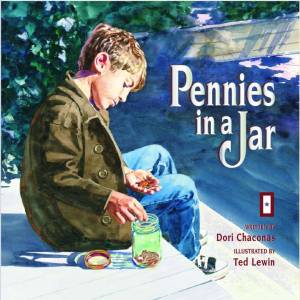
Pennies In a Jar by Dori Chaconas (Author) and Ted Lewin (Illustrator) tells the story of a young boy who promises to be brave when his father goes off to fight in World War II. The child lives in a world of air raid sirens and general wartime conditions. He, of course, meets a new friend who shows him that there are things to do for his father, even though he is so far away. Overall, this is great historical fiction for little people. Lewin provides great Rockwellian illustrations, very innocent. Chaconas is also a local Wisconsin author!
Crossing by Phillip Booth and When I Heard the Learn’d Astronomer are also in this same classic narrative vein. An old-time steam engine rumbles past in Booth’s 1957 poem “Crossing” from his debut collection Letters from a Distant Land. The nostalgic illustrations by Bagram Ibatoulline (also, illustrator for Edward Tulane) invoke a longing for the simple act of waiting at the railroad crossing, the rattling boxcars.
Walt Whitman lends his poetry to When I Heard the Learn’d Astronomer. Booklist offers a great synopsis: “Long's story-in-images makes a fine introduction for very young children. His interpretation of Whitman's eight-line rebuke of stuffy pragmatism tells a familiar story: A little boy obsessed with outer space has been dragged to an astronomy lecture. Unable to make sense of the speaker's pontifications, the fidgety youngster takes his toy rocket ship outside, where he marvels at the "perfect silence of the stars, casting a decisive vote for creative speculation over chilly analysis." I love this book so much, how rare to find a perfect adaptation of Whitman to add to a child’s important budding library.
The young boy in Wilfred Gordon Mcdonald Partridge spends his days in the retirement home next to his house. The relationships he forms with these wonderfully patient and wise elders are so darling. He is drawn on a skateboard mostly, weaving around the chairs. Wilfred’s favorite is Miss Nancy Alison Delacourt Cooper, who also has four names. Upon learning that she is losing her memory, Wilfred makes it his goal to give Miss Nancy enough of his own memories to take the place of what she has lost.
Finally, what I am most excited about this holiday season is the 10th-anniversary edition of Patricia Polacco's The Keeping Quilt, Polacco’s family story about a quilt made from an immigrant Jewish family's clothing from their Russian homeland. The story is very cyclical, chronicling the cross generational journey and multiple functions of this “keeping quilt.” The only color used is in the babushka and dress of Great-Gramma Anna, which become part of a brightly hued quilt. I love to quilt and recognize the importance of preserving one’s heritage through shared heirlooms. This book is beautiful.